Sharon Chan Cant Buy Me Love Does She Become the Princess Again
She's best known equally Thich Nhat Hanh'south invaluable collaborator, but Sis Chan Khong is likewise a dedicated activist and gifted instructor in her own correct. Andrea Miller tells her extraordinary story.
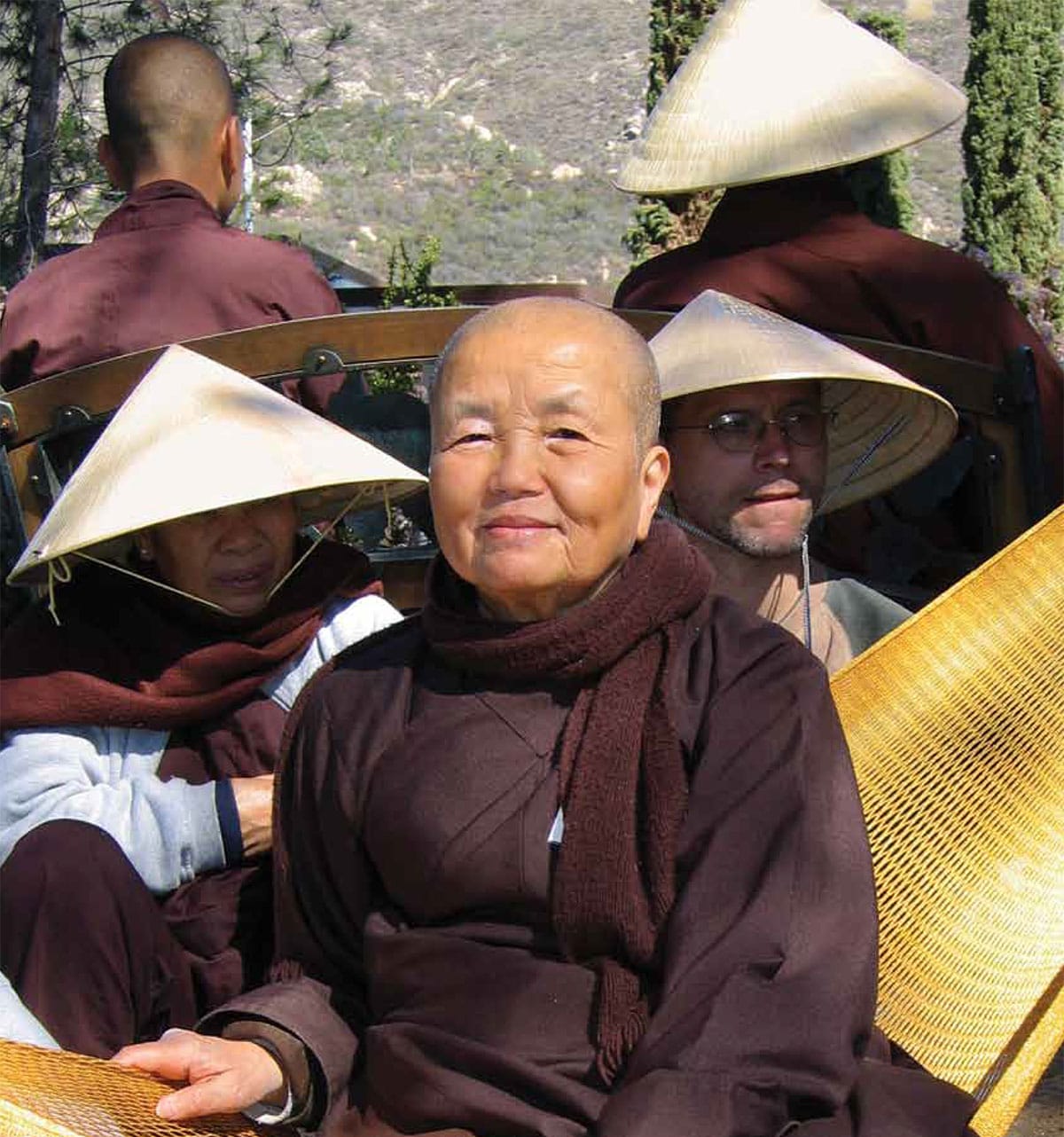
Photo by David Nelson.
Death permeated the whole trip. The inundation victims that the volunteer relief workers had come to help were either on the verge of death — starving, shivering, and homeless — or else they were dead, bloated and rotting. The volunteers themselves were also in danger. They knew that at whatever moment they could be killed in the crossfire.
This was Vietnam, 1964. The country was at state of war and now it was slammed by disaster, this inundation. The people in the conflict areas were the hardest hitting, yet no one dared to become to them with supplies. No one except this one minor squad of volunteers, including Cao Ngoc Phuong, ameliorate known today every bit Sister Chan Khong, and her teacher, the Zen master Thich Nhat Hanh.
Over a menstruum of five days, the volunteers gave away the food in their seven loaded-downward boats. Then, when they went to leave the surface area, young mothers followed them, begging them to have their babies because they saw no other hope for their children. To this solar day, Chan Khong remembers crying—her middle breaking for the mothers, for the babies. She could not have them with her.
Later Chan Khong organized other trips in which she and groups of students, monks, and nuns would travel to remote, impoverished areas and distribute rice, beans, clothing, cooking utensils, and medical supplies. One time, in a village where the fighting was peculiarly brutal, the volunteers were settling in for a night of slumber on their gunkhole when all of a sudden they heard shots and screaming. Many of the young volunteers panicked and a few of them even attempted to avoid the bullets by leaping into the river. Simply Chan Khong stood her ground — breathing deeply in and out to notice calm. This eased the panic in the others and then the whole group came together. On that dark dark in the midst of war, they chanted the Heart Sutra.
Information technology tin can even be said that her life itself is a educational activity.
Today, sister Chan Khong can count more than than 50 years of working closely with Thich Nhat Hanh. He is now a bestselling author and has centers and students beyond the globe, and she is recognized equally being a major strength that has helped him to grow his community. Only Sister Chan Khong is an accomplished teacher in her ain right and it can even exist said that her life itself is a teaching.
Start Afresh
In her community, Chan Khong is well known for leading the exercise of first anew. A four-step process, it is an opportunity to look deeply and honestly at ourselves and to work on our relationships through mindful communication. The first pace is to express appreciation for the person we're speaking to; the second is to acknowledge whatsoever unskillful action nosotros've committed against him or her; the third is to reveal how he or she has hurt us; and the quaternary is to share a difficulty that nosotros're having and to ask for support. At Plum Hamlet, the do center in French republic where Chan Khong resides, offset anew is skilful collectively every two weeks and skillful individually every bit often as necessary. Chan Khong urges lay people to practice it at dwelling house.
"Begin afresh to refresh your relationship with your children," she says. "Fifty-fifty when they're five years old, children feel pain," and frequently parents are unaware of the ways in which they hurt their children. For example, says Chan Khong, maybe a mother has hurt her son'south feelings past saying that she won't buy him the toy he wants. If, through kickoff anew, she gives her son an opportunity to express his hurt, the female parent will know to explain to him why she can't afford the toy. And so the boy will understand and resentment will not build betwixt them.
In romantic relationships, outset anew can be invaluable. Frequently, says Chan Khong, people are disappointed in their partners. At the beginning of the relationship, a woman might meet that her mate has many wonderful qualities and then she presumes that he has diverse other qualities that she finds desirable.
Merely as time goes on, she notices all the means in which he is non her platonic. "It doesn't mean that he'southward not good," says Chan Khong. "Peradventure she presumed that he was a magnolia and would behave as one. But he is actually a lotus. He is even so beautiful in his mode." "When you lot enquire your partner kindly, he volition reveal his wounds, and as he reveals them more and more, you will accept him equally he is—with his education, his culture, his way of being—and he will accept y'all more, too," she says. "Y'all will abound closer and all of a sudden y'all will non exist ii, merely one. You will take entered the world of each other. And then beginning anew is a way to brand your relationship adept with your partner, your children, your parents."
Touching the World and Total Relaxation
Brother Phap Hai, an Australian monk in the Plum Village tradition, says that in add-on to beginning anew, "full relaxation" and "touching the globe" are important dharma doors for Sister Chan Khong. Total relaxation is practiced sitting or lying downward and is an opportunity to residuum the body and mind. Touching the world, a series of meditations that Thich Nhat Hanh developed, is based on traditional Buddhist prostration do.
"All dharma teachers," says Phap Hai, "learn the basic practices, the basic framework. And then we're encouraged to make the dharma our ain—to let the dharma to express itself through the states. And Sister Chan Khong does that beautifully. I instance is her beautiful singing vocalism, which she offers in total relaxation. She too has a slap-up skill for improvisation. In touching the earth or full relaxation, she'll pick upwards on energy in the room or something that's been going on, and she'll address that. Sis Chan Khong's touching the world and total relaxation are not scripted. She's giving a living dharma talk. That'southward the fashion that she expresses her caring."
Phap Hai says Chan Khong never says no when somebody asks her for something. "I've never seen her close down her heart," he says. "For me, that is i of the qualities that I admire nearly in Sis Chan Khong, and one that I desire to develop in myself too. Sometimes I feel tired and even though I might not say no to a request at that place's still an energy of no. Only Sister Chan Khong is e'er in that location for people, and in such a loving way."
Sister Chan Khong's Early Life in Vietnam
Sister Chan Khong was born in 1938 in a village in the Mekong River Delta, a lush country of rice fields and kokosnoot groves. Her parents were, in her words, similar oak trees that sheltered twenty-2 "birds" — 9 children of their own, plus twelve nieces and nephews and ane girl from a poor family. "Female parent and Father cared for all of united states equally," Chan Khong wrote in her memoir Learning True Dear. "Feeding 20-ii mouths was a strain, just we were taught to be satisfied with and share any we had."
Her father rented plots of land to various farmers. Still whenever at that place was a drought or flood he waived the hire. He also helped farmers to buy their own state and he sometimes gave farmers coin to support their children. Chan Khong's female parent was similarly generous. She gave loans to the poor to gear up upwardly their own businesses and only if they were successful did she ask for repayment.
In her early on teens, Chan Khong caught a little boy trying to pick her pockets. He told her he had no other selection. His mother beat him whenever he came home empty-handed. "Where is your begetter?" Chan Khong asked, but the boy said he had no father. Then, post-obit him to his firm in the slums, she asked about his studies. "We don't have enough to consume," he told her. "How could I go to school?"
Chan Khong decided to find a style to help poor families such every bit the piffling boy'southward. But since her ain family unit was — as she says — "not so rich, non so poor," she didn't ask her parents for money. Instead, existence gifted academically, she raised funds by tutoring wealthy students who were struggling in math. Then, after enrolling at the University of Saigon, she branched out in her humanitarian efforts.
Chan Khong has written, "I knew that if I went to the slums equally a eye-class immature woman, the people there would know I did not vest to their world, and they would not trust me. They might fifty-fifty try to con me. So, I always went wearing a frayed dress, pretending that I had a relative living there: 'Practise you know my Uncle Ba, the bicycle rickshaw driver?' Then I would sit and listen to people talk nearly their hardships and think of ways to help them."
"You lot take a practiced heart," Chan Khong'south first Buddhist instructor told her. "With all the generous work that y'all do, y'all will be reborn into a wealthy family. Perchance you will be a princess." But Chan Khong wasn't concerned about her next life, much less the possibility of a royal pedigree. Her focus was the nowadays moment: the hungry need nutrient, the sick need medicine, and they need it correct now.
"Yous need to report scriptures more and work to become enlightened," continued her teacher. "After y'all are enlightened, you will be able to save countless beings." The idea was that if she practiced Buddhism diligently, she would exist reborn equally a homo in her adjacent life; then she might go a bodhisattva, and later still a buddha with miraculous powers. But over again Chan Khong felt alienated by these goals. She didn't want miraculous powers or to be a man, and to her this enlightenment smacked of both sexism and irrelevance.
Meeting Thich Nhat Hanh
In the autumn of 1959, Chan Khong had a chat with a prominent Buddhist monk during which she asked many questions nigh the dharma. But he didn't answer any of them. Instead, for each question he took out a book by Thich Nhat Hanh — a monk who Chan Khong had never heard of — and said, "The answer to your question is in hither." Chan Khong would accept preferred talking to the monk in front of her, but she agreed to read the material when she had time. Then a calendar month afterward, Chan Khong attended a class Nhat Hanh was teaching in Saigon. Impressed from the kickoff lecture, she felt she'd never before heard anyone speak and then beautifully and profoundly.
The following year, Chan Khong began respective with Nhat Hanh. In his first note, he wrote in his impeccable script about the mountain monastery where he lived—the moisture wood he cooked with and the cold, singing wind outside. In afterwards notes he addressed Chan Khong's concern that almost Buddhists didn't seem to care about the poor and that they viewed social work every bit mere merit work.
According to Nhat Hanh, it was possible to notice enlightenment helping those in need—or doing any other action—as long every bit it was washed mindfully. He believed that Buddhism had a neat deal to contribute to society, and he promised to support Chan Khong in her efforts. He planned to join people with the same vision and to establish villages to serve equally models for development, as well as founding training centers for workers in education, agronomics, and health care.
Thich Nhat Hanh was the instructor she had been looking for.
Inspired by his teachings and encouragement, Chan Khong organized seventy friends to help her in Saigon's slums, and they did such work as taking the sick to infirmary, establishing adult literacy classes, and on special occasions treating underprivileged children to new apparel, a repast at a eatery, and a trip to the zoo. At the same fourth dimension, Chan Khong continued to study the dharma with Nhat Hanh. From May to September 1961, she and a dozen others took a class with him and they became the "thirteen cedars," a sangha devoted to social alter.
Meanwhile, the Ngo Dinh Diem government in Due south Vietnam was warming up for a religious crackdown in which they'd try to squelch Buddhism and convert the population to Catholicism. The situation came to a head when the government forbade displaying the Buddhist flag and celebrating Wesak, the Buddha's birthday. Peaceful protests sprang upwardly and were met with a violent backlash. The authorities ordered tanks to advance on demonstrators, and tortured suspected protest instigators.
In the face of this oppression, a monk named Thich Quang Duc fabricated a powerful plea for religious freedom; on June 11, 1963 he immolated himself. "No one had informed me that he was going to practice this," writes Chan Khong in Learning True Honey, "but just at the moment he fix himself on fire, I happened to be driving past the corner of Phan Dinh Phung and Le Van Duyet Streets on my motorcycle, and I witnessed him sitting bravely and peacefully, enveloped in flames. He was completely still, while those of usa around him were crying and prostrating ourselves on the sidewalk. At that moment, a deep vow sprang along in me: I likewise would do something for the respect of man rights in every bit beautiful and gentle a way as Thay Quang Duc."
A year later, Chan Khong threw herself into working on the experimental villages that she and Nhat Hanh had envisioned. While she had been completing her biology degree, Nhat Hanh had begun grooming social workers to help bring about nonviolent social change and had spearheaded the founding of the outset village. For the second, he asked Chan Khong to have the lead, and Thao Dien — viii muddied kilometers from Saigon — was the chosen location. In July 1964, Chan Khong and a squad of other young social workers held a meeting with the villagers to propose building a school.
The government would have funded the construction if there were at least two hundred children who would attend, but in Thao Dien there were merely 70-7 children. To Chan Khong's delight, the villagers agreed to collaborate with the social workers and construct the school themselves. Some even donated building materials — palm leaves for the roof and bamboo thicket. Because the villagers were involved with this school from the ground upwards, they were proud of it and took expert care of information technology. In contrast, government-built schools in Vietnam oft required guards to foreclose vandalism.
In the experimental villages, Chan Khong and the other social workers also tackled medical care, horticulture, and child care. These projects also were successful, with the social workers respecting the villagers' points of view and involving them in solutions. Saigon's intellectuals took notice of the successes and, as a result, when Nhat Hanh announced the founding of the School of Youth for Social Service (SYSS), more than 1,000 people applied for training. Chan Khong and 5 others became its leaders.
The Wars Outside and Within
It seemed like existent change was possible, and and so the bombs fell — the Vietnam War was in full and violent swing. Tra Loc, a new experimental hamlet, was heavily damaged. The SYSS helped the villagers to rebuild each business firm, the medical center, the agronomical heart, the school. Simply once again the village was bombed. This happened over and over—the village was bombed and rebuilt, bombed and rebuilt. Frustration tempted the workers to take upwardly arms. Meditation, withal, kept them at-home.
"People think that engaged Buddhism is simply social work, only stopping the war," Chan Khong says. "But, in fact, at the aforementioned fourth dimension you stop the war exterior, you have to stop the war inside yourself."
Over her lifetime, Sister Chan Khong has learned the importance of not making peace, merely rather being peace, beingness understanding, being love—and to embody this style of being 20- four hours a day. The cardinal, she tells Panthera leo'south Roar, is to do mindfulness. "When your body and mind are not one, you do not see deeply," she says. "You lot are in front end of your brother, just your mind is on many other things, and so you don't really meet your brother. Perhaps he is having some trouble, only you don't see it, not even when y'all share the aforementioned room. Only mindfulness brings yous in that location, to the present, and then you see. Train yourself all day long to bring your mind to your torso and to exist nowadays with your food, your friends, your work, everything, because the more than y'all concentrate, the deeper yous will run across."
That said, says Chan Khong, don't expect that insight volition come all at once. "Maybe you want to assist your young brother who is drawn away by drugs, simply you cannot communicate with him easily. You lot try to exist present with him in the moment merely still you don't see how to assistance him." That'due south okay, says Chan Khong. "If yous train yourself to drive your car in the present moment, to walk in the present moment, to prepare your dinner in the nowadays moment, somewhen — mayhap while chopping vegetables— yous will accept deep insight into the way that you can handle the situation with your blood brother in a skillful way. You will know how to touch what is wonderful in him."
The precepts for monastics were formulated in some other age — more than than two millennia agone — and Thich Nhat Hanh saw they needed to be revised. He crafted xiv new precepts, which he felt were both true to the deepest teachings of the Buddha and advisable for the modernistic world. Then he invited Chan Khong and the 5 other leaders of the SYSS to receive them. This ordination made these vi the first members of what Nhat Hanh termed the Club of Interbeing, a community committed to service and mindfulness. But it did not brand them formal monks and nuns with shaved heads. Nhat Hanh gave each fellow member of this new society the option to either alive like a monastic committed to celibacy, or to live as a lay Buddhist with the freedom to marry. The iii women all chose celibacy, while the three men chose marriage.
Nhat Chi Mai, a shut friend of Chan Khong'south, was one of the original vi members of the Order of Interbeing. She was the protected, youngest child of a well-off family, and she feared the consequences of political activity. Still — like Chan Khong — she undertook the dangerous chore of spreading the word of peace. Chi Mai hid copies of Nhat Hanh'southward book Lotus in a Body of water of Fire in her Volkswagen and delivered them to schools. Then, just i year after taking the fourteen precepts, Chi Mai placed ii statues in front of her—one of the Virgin Mary and the other of Avalokitesvara — and she prepare herself on fire. Chi Mai's poems and letters urged Catholics and Buddhists to piece of work together for peace and afterwards her death they were widely read, inspiring many people. Yet, for Chan Khong, losing Chi Mai was i of the greatest sorrows of her life.
It was not, however, the only loss Chan Khong faced in 1967. A monk friend of hers was abducted that twelvemonth from Binh Phuoc Village, forth with seven other social workers. Though their bodies were never plant, it is presumed they were killed; working for the poor was considered a communist activity and the social workers had many enemies. Simply luck prevented Chan Khong from not existence made the 9th victim. She had been in Binh Phuoc Village just had left that night to visit her female parent.
Leaving Vietnam
When Chan Khong boarded a flight to Hong Kong, she planned to be gone for v days. She never imagined it would be almost 40 years before she once again set up pes in her homeland.
In 1966, two years prior to Chan Khong's difference, Nhat Hanh had besides left Vietnam believing he would but be gone for a short while. Simply at a conference in Washington, he presented a proposal urging Americans to stop bombing and to offer reconstruction assist free of political or ideological strings. The Southward Vietnamese nationalist government declared him a traitor, making it besides dangerous for him to become home, so he moved to Paris. Past 1968, however, he wanted to know whether his friends and colleagues in Vietnam needed him to chance returning. Was information technology more of import for him to be on the ground in Vietnam or to be in the West promoting peace? This was not something that could exist addressed freely in letters entering and leaving his country — they were as well heavily monitored by the government. So Nhat Hanh asked Chan Khong to meet him in Hong Kong.
There, over cups of oolong tea, she told him that she'd met privately with various Buddhist leaders in Vietnam and that they'd unanimously agreed. Nhat Hanh should not return; his skill in communicating with the West was as well valuable. Nhat Hanh decided that to more finer spread the give-and-take about what was going on in Vietnam, he needed an banana. Would Chan Khong be willing to take on that part? At kickoff, she said no—she had responsibilities in Vietnam. But after reflecting farther, she decided Nhat Hanh was right. She would be able to consequence more change in her homeland while living abroad.
In January 1969, Chan Khong joined her teacher in French republic, and they got involved with organizing a conference to present the views of Vietnam'southward voiceless majority — those people who were neither communist nor anticommunist, who just wanted peace. Out of this conference, came the Vietnamese Buddhist Peace Delegation, and Nhat Hanh was nominated to exist the chair. For her role, Chan Khong was to assistance with the administration, and she both lived and worked out of the delegation's small-scale office, a rental in a poor Parisian neighborhood. The projects that they took on were varied and included raising money for orphans in Vietnam and producing a newsletter in French, English, and Vietnamese. Chan Khong traveled throughout Europe and the United States speaking to audiences almost the need for an immediate ceasefire.
Finally, on April 30, 1975, the war came to an end. The suffering, nonetheless, did not. Terrified of communist rule, refugees began risking everything to flee Vietnam. If the regime defenseless them trying to escape, they were either imprisoned or shot. If they succeeded in making it to sea, they were prey to pirates. And if they reached a foreign shore, they were frequently turned abroad—their rickety boats pushed dorsum out into the water.
On the seas, I was fearless, fifty-fifty when faced by pirates, and I was fifty-fifty blithesome because I knew I was going in the direction of beauty.
Chan Khong'south despair was intense. There seemed to exist nix she could do to save her compatriots from the raping and robbing and killing. After months of meditation, however, she determined her path of action and initiated a rescue project. Chan Khong rented a angling boat in Thailand, dressed upwards like a fisherman, and went out to sea to "fish" the boat people. Every time she and her team came across a refugee boat, they gave them food, fuel, and directions to the nearest refugee military camp. In an interview with Alan Senauke and Susan Moon, which appeared in Turning Bicycle, Chan Khong said: "Meditation allowed me to transform the garbage, the suffering, in me into a mercy fishing boat. On the seas, I was fearless, even when faced by pirates, and I was even blithesome because I knew I was going in the management of beauty."
In 1988, Chan Khong formally ordained every bit a nun. "Shaving the head, all attachments are cut off," Thich Nhat Hanh said as he snipped her pilus.
A Nun in the West
Of being a monastic in the West, Chan Khong has written: "I do not carry undernourished babies in my arms, simply teenagers and adults exercise weep silently as they share the stories of their childhoods of sadness and corruption. Past listening attentively to their pain and helping them renew themselves, I am able to assist heal many of these wounded 'children,' and this is very close to my platonic of holding the village children in my artillery. I am grateful to be able to assist in this way." As a nun in the West, Chan Khong has played a fundamental function in developing Thich Nhat Hanh's international community. In 1982, they moved to what is now known equally Plum Hamlet, ii bucolic parcels of farmland in France. For the heart's outset retreat, the 107 attendees used wooden planks equally beds and sleeping numberless for blankets, and they did not have a sufficient number of restrooms. In a dharma talk published in the volume I Take Arrived, I Am Home, Chan Khong said: "There was only one restroom for the unabridged Lower Hamlet, 1 for both showering and using the toilets! It was the same at the Upper Hamlet. Seeing the situation, the male person retreatants took upwardly shovels and dug 2 'combat' latrines."
Yet attendees were not put off by the atmospheric condition, and at subsequent retreats the numbers grew exponentially. Today Plum Village is less rustic, just still simple, and people from all over the globe go in that location to practice. They as well go to other centers in the Plum Hamlet tradition: Deer Park Monastery in California, Blue Cliff Monastery in New York State, and the European Institute of Applied Buddhism in Germany.
In 2005, the Vietnamese government permitted Sister Chan Khong and Thich Nhat Hanh to visit their homeland for the get-go time since the sixties. While there, they traveled the country accompanied by members of their sangha and made connections with the Vietnamese people, especially the immature. Two more than visits were permitted — 1 in 2007 and the other in 2008. Since and then, however, they take non been welcome. The Vietnamese government felt threatened by the large number of educated youth drawn to Thich Nhat Hanh'south teachings.
According to Nhat Hanh, Chan Khong came to him as a student but she likewise has been a teacher for him. When the Vietnam State of war was raging, Nhat Hanh was and so preoccupied with how to stop the fighting that it became difficult for him to eat. One twenty-four hours, Chan Khong was preparing herbs to serve with rice noodles, when she asked Nhat Hanh if he could identify them. "Looking at her displaying the herbs with care and beauty on a large plate, I became enlightened," he has written. "She had the ability to keep her attending on the herbs, and I realized I had to stop dwelling just on the war and learn to concentrate on the fine herbs also." They spent ten minutes talking near the herbs of Vietnam, and that come across took Nhat Hanh's mind off the war, allowing him to recover the balance he needed.
"A single person is capable of helping many living beings," Nhat Hanh said in his book, Be Free Where Y'all Are. "My colleague Sister Chan Khong has been working with poor people, orphans, and the hungry for many years. She has helped thousands and thousands of people, and because of her work these people suffer less. This brings her a lot of joy and gives her life meaning. This tin can exist true for all of the states anytime, anywhere."

Source: https://www.lionsroar.com/path-of-peace-the-life-and-teachings-of-sister-chan-khong-may-2012/

إرسال تعليق for "Sharon Chan Cant Buy Me Love Does She Become the Princess Again"