Family of Pope Urban Ii Pope Urban Ii
| Pope Blessed Urban 2 | |
|---|---|
| Bishop of Rome | |
| Church | Catholic Church |
| Papacy began | 12 March 1088 |
| Papacy concluded | 29 July 1099 |
| Predecessor | Victor III |
| Successor | Paschal 2 |
| Orders | |
| Ordination | c. 1068 |
| Consecration | twenty July 1085 |
| Created cardinal | 1073 by Gregory VII |
| Personal details | |
| Nascency proper name | Odo |
| Born | c. 1035[ane] Lagery, County of Champagne, Kingdom of French republic |
| Died | (1099-07-29)29 July 1099 (aged 64) Rome, Papal States, Holy Roman Empire |
| Previous postal service(s) |
|
| Sainthood | |
| Feast mean solar day | 29 July |
| Venerated in | Catholic Church building |
| Beatified | fourteen July 1881 Rome past Pope Leo XIII |
| Attributes |
|
| Other popes named Urban | |
Pope Urban II (Latin: Urbanus Ii; c. 1035 – 29 July 1099), otherwise known every bit Odo of Châtillon or Otho de Lagery,[ii] [A] was the caput of the Catholic Church and ruler of the Papal States from 12 March 1088 to his expiry. He is best known for initiating the Crusades.[3] [4]
Pope Urban was a native of France, and was a descendant of a noble family from the French commune of Châtillon-sur-Marne.[5] [six] Reims was the nearby cathedral school where he began his studies in 1050.[vii]
Before his papacy, Urban was the grand prior of Cluny and bishop of Ostia.[8] As pope, he dealt with Antipope Cloudless Three, infighting of various Christian nations, and the Muslim incursions into Europe. In 1095 he started preaching the First Crusade (1095–99). He promised forgiveness and pardon for all of the past sins of those who would fight to reclaim the holy country from Muslims and free the eastern churches.[9] This pardon would too apply to those that would fight the Muslims in Spain. While the Showtime Cause resulted in the liberation of Jerusalem from the Fatimids, Pope Urban II died before he could receive this news.
He also set up the modern-24-hour interval Roman Curia in the manner of a royal ecclesiastical courtroom to help run the Church.[10]
He was beatified by Pope Leo 13 on 14 July 1881.
Bishop of Ostia [edit]
Urban, baptized Eudes (Odo), was born to a family of Châtillon-sur-Marne.[11] [12] He was prior of the abbey of Cluny,[11] after Pope Gregory VII named him cardinal-bishop of Ostia c. 1080. He was 1 of the most prominent and active supporters of the Gregorian reforms, especially as legate in the Holy Roman Empire in 1084. He was amidst the three whom Gregory VII nominated equally papabile (possible successors). Desiderius, the abbot of Monte Cassino, was chosen to follow Gregory in 1085 but, subsequently his curt reign equally Victor III, Odo was elected by acclaim at a small meeting of cardinals and other prelates held in Terracina in March 1088.
Papacy [edit]
[edit]
From the beginning, Urban had to reckon with the presence of Guibert, the sometime bishop of Ravenna who held Rome as the antipope "Clement III". Gregory had repeatedly clashed with the emperor Henry Iv over papal dominance. Despite the Walk to Canossa, Gregory had backed the rebel Duke of Swabia and again excommunicated the emperor. Henry finally took Rome in 1084 and installed Cloudless III in his place.
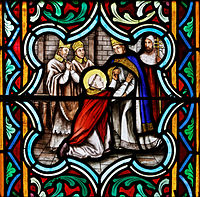
Urban took up the policies of Pope Gregory Vii and, while pursuing them with determination, showed greater flexibility and diplomatic finesse. Usually kept away from Rome,[13] Urban toured northern Italy and French republic. A series of well-attended synods held in Rome, Amalfi, Benevento, and Troia supported him in renewed declarations against simony, lay investitures, clerical marriages (partly via the cullagium revenue enhancement), and the emperor and his antipope. He facilitated the marriage of Matilda, countess of Tuscany, with Welf Two, duke of Bavaria. He supported the rebellion of Prince Conrad against his father and bestowed the office of groom on Conrad at Cremona in 1095.[xiv] While there, he helped arrange the marriage between Conrad and Maximilla, the daughter of Count Roger of Sicily, which occurred after that year at Pisa; her large dowry helped finance Conrad's continued campaigns.[14] The Empress Adelaide was encouraged in her charges of sexual compulsion against her husband, Henry IV. He supported the theological and ecclesiastical piece of work of Anselm, negotiating a solution to the cleric's impasse with Rex William 2 of England and finally receiving England'due south support against the Imperial pope in Rome.
Urban maintained vigorous support for his predecessors' reforms, however, and did not shy from supporting Anselm when the new archbishop of Canterbury fled England. Likewise, despite the importance of French support for his crusade, he upheld his legate Hugh of Die'southward excommunication of Male monarch Philip over his doubly bigamous spousal relationship with Bertrade de Montfort, married woman of the Count of Anjou. (The ban was repeatedly lifted and reimposed as the king promised to forswear her and then repeatedly returned to her. A public penance in 1104 ended the controversy,[fifteen] although Bertrade remained active in attempting to encounter her sons succeed Philip instead of Louis.[16])
First Crusade [edit]
Urban Ii's movement took its beginning public shape at the Council of Piacenza, where, in March 1095,[17] Urban 2 received an ambassador from the Byzantine Emperor Alexios I Komnenos asking for aid against the Muslim Seljuk Turks who had taken over most of formerly Byzantine Anatolia.[eighteen] The Quango of Clermont met, attended by numerous Italian, Burgundian, and French bishops. All of the sessions except the final one took place either in the cathedral of Clermont or in the suburban church building of Notre-Dame-du- Port.
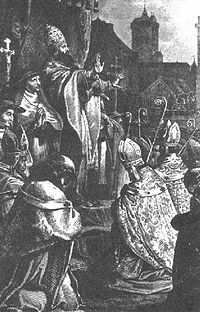
Though the Council was primarily focused on reforms inside the church hierarchy, Urban 2 gave a speech on 27 November 1095 at the conclusion of the Council to a broader audience.[19] The speech was made outside in the open up air to accommodate the vast crowd that had come to hear him.[xx] Urban II'south sermon proved highly effective, as he summoned the attention dignity and the people to wrest the Holy Country, and the eastern churches more often than not, from the control of the Seljuk Turks.[21] This was the speech that triggered the Crusades.

Urban at Clermont (14th-century miniature)
There exists no exact transcription of the speech that Urban delivered at the Council of Clermont. The five extant versions of the speech were written down some time later, and they differ widely from one another.[22] All versions of the oral communication except that past Fulcher of Chartres were probably influenced by the chronicle account of the Kickoff Crusade called the Gesta Francorum (written c. 1101), which includes a version of it.[23] Fulcher of Chartres was present at the Quango, though he did not showtime writing his history of the cause, including a version of the speech communication until c. 1101.[24] Robert the Monk may have been present,[25] only his version dates from about 1106. The v versions of Urban's speech likely reflect much more than conspicuously what later authors idea Urban Ii should accept said to launch the Offset Crusade than what Urban II actually did say.
As a better means of evaluating Urban's truthful motives in calling for a cause to the Holy Lands, there are four extant letters written by Pope Urban himself: one to the Flemish (dated December 1095);[26] one to the Bolognese (dated September 1096); one to Vallombrosa (dated October 1096); and 1 to the counts of Catalonia (dated either 1089 or 1096–1099). However, whereas the three former letters were concerned with rallying popular support for the Crusades, and establishing the objectives, his letters to the Catalonian lords instead beseech them to keep the fight against the Moors, assuring them that doing so would offering the same divine rewards equally a disharmonize confronting the Seljuks.[27] Information technology is Urban Two's ain letters, rather than the paraphrased versions of his speech at Clermont, that reveal his actual thinking about crusading. All the same, the versions of the speech have had a slap-up influence on popular conceptions and misconceptions near the Crusades, so it is worth comparing the five equanimous speeches to Urban'southward actual words. Fulcher of Chartres has Urban saying that the Lord and Christ beseech and control the christians to fight and reclaim their state. [28]
The chronicler Robert the Monk put this into the oral fissure of Urban II:
... this state which you inhabit, shut in on all sides by the seas and surrounded past the mountain peaks, is too narrow for your large population; nor does information technology abound in wealth; and information technology furnishes scarcely food enough for its cultivators. Hence it is that you murder one some other, that y'all wage state of war, and that often you perish by mutual wounds. Permit therefore hatred depart from among y'all, let your quarrels end, allow wars cease, and let all dissensions and controversies slumber. Enter upon the route to the Holy Sepulchre; wrest that land from the wicked race, and subject it to yourselves ... God has conferred upon you lot to a higher place all nations great glory in arms. Appropriately undertake this journey for the remission of your sins, with the balls of the imperishable glory of the Kingdom of Sky.
Robert continued:
When Pope Urban had said these ... things in his urbane discourse, he and then influenced to one purpose the desires of all who were present, that they cried out "It is the volition of God! It is the will of God!". When the venerable Roman pontiff heard that, [he] said: "Nearly beloved brethren, today is manifest in you what the Lord says in the Gospel, 'Where two or three are gathered together in my name there am I in the midst of them.' Unless the Lord God had been present in your spirits, all of you would non have uttered the same cry. For, although the weep issued from numerous mouths, yet the origin of the cry was one. Therefore I say to you that God, who implanted this in your breasts, has drawn it forth from you. Let this then exist your state of war-cry in combats, because this word is given to you by God. When an armed attack is made upon the enemy, let this one cry be raised by all the soldiers of God: Information technology is the will of God! It is the volition of God!"[29]
Within Fulcher of Chartres account of pope Urban's speech there was a promise of remission of sins for whoever took part in the crusade.
All who die by the way, whether by land or by sea, or in battle against the pagans, shall have firsthand remission of sins. This I grant them through the power of God with which I am invested.[28]
It is disputed whether the famous slogan "God wills it" or "It is the will of God" (deus vult in Latin, Dieu le veut in French) in fact was established equally a rallying cry during the Council. While Robert the Monk says so,[30] it is likewise possible that the slogan was created as a catchy propaganda motto after.
Urban II's own letter to the Flemish confirms that he granted "remission of all their sins" to those undertaking the enterprise to liberate the eastern churches.[9] One notable dissimilarity with the speeches recorded by Robert the Monk, Guibert of Nogent, and Baldric of Dol is the lesser accent on Jerusalem itself, which Urban merely once mentions as his own focus of concern. In the letter to the Flemish he writes, "they [the Turks] accept seized the Holy City of Christ, embellished past his passion and resurrection, and blasphemy to say—have sold her and her churches into abominable slavery." In the messages to Bologna and Vallombrosa he refers to the crusaders' desire to fix out for Jerusalem rather than to his own want that Jerusalem be freed from Muslim dominion. It was believed that originally that Urban wanted to send a relatively minor force to aid the Byzantines, nonetheless after coming together with 2 prominent members of the crusades Adhemar of Puy and Raymond of Saint-Guilles, Urban decided to rally a much larger force to retake Jerusalem.[31] Urban II refers to liberating the church as a whole or the eastern churches generally rather than to reconquering Jerusalem itself. The phrases used are "churches of God in the eastern region" and "the eastern churches" (to the Flemish), "liberation of the Church building" (to Bologna), "liberating Christianity [Lat. Christianitatis]" (to Vallombrosa), and "the Asian church" (to the Catalan counts). Coincidentally or not, Fulcher of Chartres'due south version of Urban'south speech makes no explicit reference to Jerusalem. Rather information technology more more often than not refers to aiding the crusaders' Christian "brothers of the eastern shore," and to their loss of Asia Modest to the Turks.[32]
It is still disputed what Pope Urban'due south motives were as evidenced by the different speeches that were recorded, all of which differ from each other. Some historians believe that Urban wished for the reunification of the eastern and western churches, a rift that was caused past the Great Schism of 1054. Others believe that Urban saw this as an opportunity to gain legitimacy as the pope as at the time he was contending with the antipope Clement III. A third theory is that Urban felt threatened by the Muslim incursions into Europe and saw the crusades as a mode to unite the christian earth into a unified defense against them.[33]
The near important issue of the First Crusade for Urban himself was the removal of Clement Three from Rome in 1097 by one of the French armies.[34] His restoration there was supported by Matilda of Tuscany.[35]
Urban Two died on 29 July 1099, fourteen days after the fall of Jerusalem to the Crusaders, but before news of the effect had reached Italian republic; his successor was Pope Paschal Two.
Spain [edit]
Urban also gave support to the crusades in Spain against the Moors there. Pope Urban was concerned that the focus on the east and Jerusalem would fail the fight in Espana. He saw the fight in the east and in Kingdom of spain as role of the same crusade then he would offer the same remission of sin for those that fought in Kingdom of spain and discouraged those that wished to travel east from Spain.[36]
Sicily [edit]
Urban received vital support in his conflict with the Byzantine Empire, Romans and the Holy Roman Empire from the Norman of Campania and Sicily. In render he granted Roger I the freedom to appoint bishops as a right of ("lay investiture"), to collect Church revenues earlier forwarding to the papacy, and the right to sit in judgment on ecclesiastical questions.[37] Roger I virtually became a legate of the Pope inside Sicily.[38] In 1098 these were extraordinary prerogatives that Popes were withholding from temporal sovereigns elsewhere in Europe and that subsequently led to bitter confrontations with Roger's Hohenstaufen heirs.
Veneration [edit]
Pope Urban was beatified in 1881 past Pope Leo Xiii with his feast twenty-four hours on 29 July.[39] [forty]
See likewise [edit]
- Business firm of Châtillon
- House of Natoli
- Beauvais Cathedral
- Milo of Nanteuil
- Concordat of Worms
- Gregorian Reforms
- Investiture Controversy
- Cardinals created by Urban II
Footnotes [edit]
- ^ Alternatively, Otto, Odo, or Eudes.
References [edit]
- ^ Key Figures in Medieval Europe: An Encyclopedia: "Urban II, Pope (c.1035-1099, r.1088-1099)"
- ^ Celli-Fraentzel 1932, p. 97.
- ^ Richard Urban Butler (1912). "Pope Bl. Urban II". In Cosmic Encyclopedia. fifteen. New York: Robert Appleton Company.
- ^ Theodore Freylinghuysen Collier (1911). "Urban (popes)". In Chisholm, Hugh (ed.). Encyclopædia Britannica. 27. (11th ed.), Cambridge Academy Press. pp. 789-792.
- ^ Fundamental Figures in Medieval Europe: An Encyclopedia - Page 641
- ^ Kleinhenz, Ch.Medieval Italy: An Encyclopedia
- ^ Gabriele, p. 796. sfn error: no target: CITEREFGabriele (help)
- ^ Becker & 1:24–ninety. sfn mistake: no target: CITEREFBecker1:24–ninety (help)
- ^ a b Peters 1971, p. 16.
- ^ McBrien 2000, p. 182.
- ^ a b McBrien 2000, p. 190.
- ^ Kleinhenz 2004, p. 1112.
- ^ Peters 1971, p. 33.
- ^ a b Robinson, I.S. (4 December 2003), Henry IV of Frg, 1056–1106, p. 291, ISBN9780521545907 .
- ^ Philip I of French republic and Bertrade, Dissolving Majestic Marriages: A Documentary History, 860–1600, ed. David d'Avray, (Cambridge University Press, 2014), 47.
- ^ Orderic Vitalis.
- ^ The synod took place on one–vii March 1095; the Pope stayed in Piacenza until the 2nd week in April: P. Jaffé, Regesta pontificum Romanorum, editio secunda, I (Leipzig 1885), p. 677.
- ^ Peters 1971, p. xiv.
- ^ Peters 1971, p. 1.
- ^ Blumenthal, Utah-Renata. The Crusades - An Encyclopedia. pp. 263-265.
- ^ Peters 1971, p. sixteen, ane-fifteen.
- ^ Peters 1971, p. one-15.
- ^ Peters 1971, p. 2-x.
- ^ Peters 1971, p. 23.
- ^ Peters 1971, p. 2.
- ^ Peters 1971, p. 15-16.
- ^ H.E.J. Cowdrey, "Pope Urban II's Preaching of the First Crusade," History, 55 (1970), p. 185-7.
- ^ a b Fulcher of Chartres' account of Urban'southward speech, Urban Ii: Oral communication at Council of Clermont, 1095, Five versions of the Voice communication (available as function of the Internet Medieval Sourcebook).
- ^ Robert the Monk's account of Urban'due south voice communication, Urban Two: Spoken communication at Council of Clermont, 1095, 5 versions of the Spoken communication (bachelor every bit part of the Internet Medieval Sourcebook).
- ^ Peters 1971, p. xix.
- ^ Baldwin, Marshall W. (1940). "Some Recent Interpretations of Pope Urban Ii's Eastern Policy". The Catholic Historical Review. 25 (four): 459–466. JSTOR 25013850.
- ^ Quotes from Urban 2's letters taken from "Crusades, Idea and Reality, 1095–1274"; Documents of Medieval History four; eds. Louise and Johnathan Riley-Smith, London 1981, 37–40.
- ^ Baldwin, Marshall W. (1940). "Some Recent Interpretations of Pope Urban II's Eastern Policy". The Catholic Historical Review. 25 (iv): 462–466. JSTOR 25013850.
- ^ Peters 1971, p. 33-34.
- ^ Peters 1971, p. 34.
- ^ Chevedden, Paul Eastward. (2011). "The View of the Crusades from Rome and Damascus: The Geo-Strategic and Historical Perspectives of Pope Urban II and ʿAlī ibn Ṭāhir al-Sulamī". Oriens. 39 (2): 270–271. doi:10.1163/187783711X588132. JSTOR 23072750.
- ^ Loud 2013, p. 231-232.
- ^ Matthew 1992, p. 28.
- ^ McBrien 2000, p. 192.
- ^ "Archived copy". Archived from the original on six Dec 2008. Retrieved 22 Baronial 2008.
{{cite web}}: CS1 maint: archived copy every bit title (link)
Bibliography [edit]
- Becker, Alfons (1988). Papst Urban II. (1088-1099) (in German). Stuttgart: A. Hiersemann. ISBN9783777288024.
- Celli-Fraentzel, Anna (Jan 1932). "Contemporary Reports on the Mediaeval Roman Climate". Speculum. 7 (1): 96–106. doi:10.2307/2848328. JSTOR 2848328. S2CID 161324202.
- Crozet, R. (1937). "Le voyage d'Urbain Ii et ses arrangements avec le clergé de French republic (1095-1096)" : Revue historique 179 (1937) 271-310.
- Gossman, Francis Joseph (1960. Pope Urban II and Canon Law (The Catholic University of America Canon Law Studies 403) Washington 1960.
- Loud, Graham (2013). The Age of Robert Guiscard: Southern Italy and the Northern Conquest (ii ed.). Routledge. ISBN978-0-582-04529-3.
- Matthew, Donald (1992). The Norman Kingdom of Sicily. Cambridge University Press. ISBN978-0521269117.
- McBrien, Robert P. (2000). Lives of the Popes. HarperCollins. ISBN9780060653040.
- Peters, Edward, ed. (1971). The First Crusade. Philadelphia: University of Pennsylvania Press. ISBN978-0812210170.
- Rubenstein, Jay (2011). Armies of Sky: The First Crusade and the Quest for Apocalypse. Basic Books. ISBN978-0-465-01929-viii.
- Kleinhenz, Christopher (2004). Medieval Italy: An Encyclopedia. Routledge. ISBN9781135948801.
- Somerville, Robert (1970). "The French Councils of Pope Urban II: Some Basic Considérations," Annuarium historiae conciliorum 2 (1970) 56-65.
- Somerville, Robert (1974). "The Council of Clermont (1095), and Latin Christian Order". Archivum Historiae Pontificiae. 12: 55–90. JSTOR 23563638.
- Somerville, Robert (2011). Pope Urban Two's Council of Piacenza. OUP Oxford. p. 10. ISBN978-0-nineteen-925859-eight.
External links [edit]
- Five versions of his speech for the First Crusade from Medieval Sourcebook.
- Medieval Lands Project on Eudes de Châtillon, Bishop of Ostia, Pope Urban II, the son of Milon the seigneur of Châtillon in the 11th century
- Urban's call for the 1095 crusade
- "Pope Urban Ii". Repertorium "Historical Sources of the German Middle Ages" ( Geschichtsquellen des deutschen Mittelalters ).
- Literature by and nearly Pope Urban II in the German National Library catalogue
- Works by and nigh Pope Urban 2 in the Deutsche Digitale Bibliothek (German Digital Library)
- Publications near Urban 2 in the OPAC of the Regesta Imperii
- Gabriele, M. (xi December 2012). The Last Carolingian Exegete: Pope Urban 2, the Weight of Tradition, and Christian Reconquest. Retrieved 24 Nov 2017. doi:x.1017/S0009640712001904
Source: https://en.wikipedia.org/wiki/Pope_Urban_II

إرسال تعليق for "Family of Pope Urban Ii Pope Urban Ii"